I spent
this winter in northwestern Montana close to
the border of Idaho’s Panhandle, a place well known for its dense population of wolves. To hear hunters tell it, I should have seen a deer or elk skeleton every few feet on the forest
floor, and a lurking wolf behind every tree. Game numbers have plummeted, they
claim, as they affix SSS stickers ?-- standing for Shoot, Shovel, and Shut-up
-- on pickups, and don baseball caps that urge, “Smoke a Pack a Day.” And
they’re not talking about cigarettes.
I own guns. I support hunting, and the elk and deer meat from these forests is luscious. An avid naturalist, I’ve walked, skied and driven hundreds of miles over these mountains for eight months, including every day during bow and rifle season.

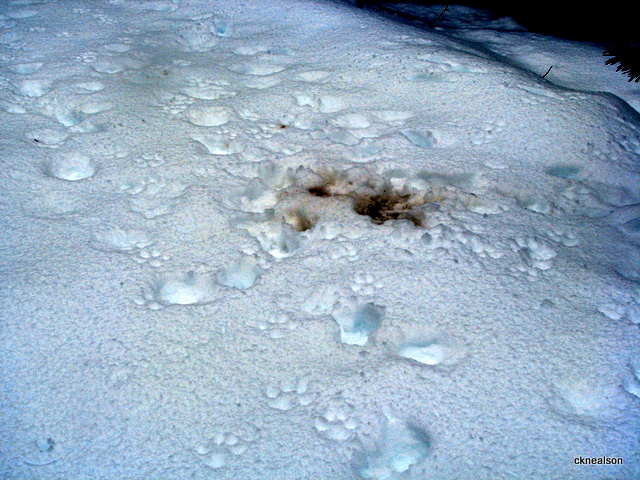
Yet it took three months before I spotted wolf tracks and scat. It was in November, the final week of rifle season. Three months later, I saw my first wolf. Wolf sign did not become common until late winter mating season, when scat and blood-laced urine appeared twice in one week in the high country along creek drainages.
What I saw on the ground never matched the stories I heard or read in the newspapers, which blamed wolves for killing off the game. My experience came closer to the claim of Kent Laudon, state wolf biologist, who estimates there’s one wolf for every 39 square miles of game terrain in the Department of Fish, Wildlife and Parks’ Region One in northwestern Montana. He estimates pack size at 6.7 animals.
Coming from Colorado, a state that manages elk herds with sharpshooters and silencers, I was unprepared for the vitriol toward wolves. When I listened to hunters gathered around camo-decorated crockpots, they seemed to enjoy trashing these animals. One line of attack went like this: “If we can’t eat game, we’ll be forced to move to town. It’s rural cleansing. Next, they’ll take away our guns.” Hunting guides complained that out-of-state clients were reluctant to come to wolf-infested woods. Some taxidermists said they had lost business, while ranchers claimed that wolf packs threatened their livelihoods. Yet the figures show that only 97 cows were killed by wolves in Montana in 2009. During that year, government statistics showed that 2.6 million cattle, including calves, lived in the state; therefore, the percentage of cattle killed by wolves was only 0.004 percent.
Montana Fish, Wildlife and Parks cites a 15 percent increase in the wolf population from 2010 to 2011, to around 653, as the justification for increasing the quota for the 2012 wolf hunt. However, according to Jay Mallonee, an independent wolf researcher who writes for “Friends of Animals,” both figures are incorrect and impossible to substantiate (Nature and Science Magazine: wolfandwildlifestudies.com/downloads/natureandscience.pdf
I own guns. I support hunting, and the elk and deer meat from these forests is luscious. An avid naturalist, I’ve walked, skied and driven hundreds of miles over these mountains for eight months, including every day during bow and rifle season.

Yet it took three months before I spotted wolf tracks and scat. It was in November, the final week of rifle season. Three months later, I saw my first wolf. Wolf sign did not become common until late winter mating season, when scat and blood-laced urine appeared twice in one week in the high country along creek drainages.
What I saw on the ground never matched the stories I heard or read in the newspapers, which blamed wolves for killing off the game. My experience came closer to the claim of Kent Laudon, state wolf biologist, who estimates there’s one wolf for every 39 square miles of game terrain in the Department of Fish, Wildlife and Parks’ Region One in northwestern Montana. He estimates pack size at 6.7 animals.
Coming from Colorado, a state that manages elk herds with sharpshooters and silencers, I was unprepared for the vitriol toward wolves. When I listened to hunters gathered around camo-decorated crockpots, they seemed to enjoy trashing these animals. One line of attack went like this: “If we can’t eat game, we’ll be forced to move to town. It’s rural cleansing. Next, they’ll take away our guns.” Hunting guides complained that out-of-state clients were reluctant to come to wolf-infested woods. Some taxidermists said they had lost business, while ranchers claimed that wolf packs threatened their livelihoods. Yet the figures show that only 97 cows were killed by wolves in Montana in 2009. During that year, government statistics showed that 2.6 million cattle, including calves, lived in the state; therefore, the percentage of cattle killed by wolves was only 0.004 percent.
Montana Fish, Wildlife and Parks cites a 15 percent increase in the wolf population from 2010 to 2011, to around 653, as the justification for increasing the quota for the 2012 wolf hunt. However, according to Jay Mallonee, an independent wolf researcher who writes for “Friends of Animals,” both figures are incorrect and impossible to substantiate (Nature and Science Magazine: wolfandwildlifestudies.com/downloads/natureandscience.pdf

By its own
admission, Montana’s
wildlife agency has oversold doe tags in the past. Laudon confirms that while a
few deer herds are down in numbers, other herds are stable or increasing. A
predation study is currently under way at the University of Montana.
Early reports point to mountain lions, which are three times more numerous than
wolves, according to Laudon, as the primary cause of elk calf deaths.
Meanwhile, the state uses anecdotal sightings to help it determine wolf counts.
This May, wildlife commissioners will consider their options for the 2012- ‘13 wolf season and make a final decision in July. Will wolf kills be determined by the bully pulpit and defined by how many deer and elk show up in people’s backyards? Or will the commissioners consider a combination of factors and try to balance game-tag distribution, hunting pressure and poaching, game counts, herd movements and natural deaths?
Restoring wolves to Montana has affected everything. A game-changer in the literal sense, it takes some getting used to. Wolf packs have sharpened the wits of the ungulates, forcing them to alter the way they move through the forest. Hunters now have to deal with game that no longer behaves in traditional ways. Meanwhile, the anti-wolf contingent batters the public with relentless horror stories about wolves, hoping to convince people that all the game has disappeared. That is not true, of course, but is anybody getting the facts beyond the rhetoric?
This May, wildlife commissioners will consider their options for the 2012- ‘13 wolf season and make a final decision in July. Will wolf kills be determined by the bully pulpit and defined by how many deer and elk show up in people’s backyards? Or will the commissioners consider a combination of factors and try to balance game-tag distribution, hunting pressure and poaching, game counts, herd movements and natural deaths?
Restoring wolves to Montana has affected everything. A game-changer in the literal sense, it takes some getting used to. Wolf packs have sharpened the wits of the ungulates, forcing them to alter the way they move through the forest. Hunters now have to deal with game that no longer behaves in traditional ways. Meanwhile, the anti-wolf contingent batters the public with relentless horror stories about wolves, hoping to convince people that all the game has disappeared. That is not true, of course, but is anybody getting the facts beyond the rhetoric?
~~~
Bob Ream, Chairman
(406) 461-3202
(406) 461-3202